 ***SPOILERS AHEAD***
My arduous path to seeing Christopher Nolan’s The Odyssey in IMAX had a Homeric quality of its own.
Week after week, I diligently reviewed the listings for my local AMC IMAX theater. Complete sellouts gave way to a solid month of showings in which only the first three rows were available.
Refusing to spend three hours staring straight up, I waited. But waiting brought risk. Would Spider-Man occupy all of the IMAX space until The Odyssey had run its course?
Thankfully, this past weekend, I saw the film at long last. From the sixth row. Right in the middle.
It was worth the wait.
The Odyssey is a beautifully made film with an artfully told story. This is entirely unsurprising in the hands of Christopher Nolan, but so much was written and said about the film before it was even released that it’s worth mentioning this obvious truth at the outset.
The Odyssey is the kind of film that makes me want to learn more about its locations and the techniques used to create it. Famously, Nolan opts for practical effects whenever possible (see also Oppenheimer), and that preference makes the scenes in The Odyssey all the more striking.
It is refreshing in 2026 to watch a movie and think “How did he do that?” far more often than “Well, this is obviously all shot in front of a green screen with the actors staring at tennis balls on strings” or “I’m not even sure the actors are all physically in the same room.”
The visual aspects aside, the performances are generally excellent and tonally appropriate. Anne Hathaway, Tom Holland, and Jon Bernthal are all very strong. Matt Damon will undoubtedly be nominated for Best Actor, and I think Robert Pattinson has an excellent chance to win Best Supporting Actor. Pattinson’s Antinous is especially outstanding, as he perfectly balances pure evil and cowardice with strategic false nobility (which never fools Penelope).
Watching a western film set in a pre-Christian era is fascinating because the default moral framework from which westerners have been operating for, oh, about 2,000 years simply doesn’t exist yet. Certain ideas that have been offensive to most westerners for somewhere between decades and centuries, such as human and animal sacrifice, are simply a part of the religious and moral fabric of the world depicted in The Odyssey.
The core of the film is deeply rooted in the notion of the law of the gods, offending the gods, and what lessons may be taken from ruminating on those questions. And that theological framework bears some vague resemblance to our own, but its key tenets—especially for purposes of relevance to this plot—are certainly distinct. I’ll return to that in a moment. First, back to the cast.
Now that I’ve seen the movie, I’m compelled to say that the people who freaked out about the casting, or shrieked that the movie is too “woke,” seem silly at best. At worst, they’re grifting to get clicks and money from people who haven’t seen the movie and never will.
There are a few lines from Anne Hathaway that do seem a bit anachronistic and anchored in far more modern feminism, but they’re barely noticeable in the context of the larger piece. And Elliot Page should never have had a scene that involved running. As Bridget Phetasy pointed out, it’s impossible to hide or change that.
My one actual quibble with the movie is Nolan’s decision to make Clytemnestra Helen’s identical twin, rather than a half-sister, as I believe she is in the original.
I don’t care much about dramatic license taken by a filmmaker in an adaptation, so long as it doesn’t undermine a core story element. This change does so. If Helen’s is “the face that launched a thousand ships,” with her unique beauty fueling her kidnaping that sparks a war, doesn’t it weaken that impact if there is another face that is identical to hers?
Put another way, if you want me to accept that Lupita Nyong’o is a singular beauty, I’ll go with that. But if you then tell me that this singular beauty is definitionally not singular, then we have a problem.
As I said, though, this is a minor point. The movie is very good and quintessentially “Nolan.” As with all of his films, except for the Batman trilogy (which I genuinely sometimes forget are his, because they’re so straightforward), time plays a critical role as a storytelling device.
Nolan deftly uses flashback and non-sequential story beats to tie plot points together as the film progresses. The fact that the film spans roughly 20 years provides Nolan with myriad opportunities to do so. Although not as daunting as Memento or Tenet, there is an aspect of challenging the audience to connect thematically related but temporally distant events. This is one of Nolan’s many strong suits, and he handles it as expertly as ever.
 I also want to take a moment to confess that there was one scene in the movie that made me legitimately, embarrassingly emotional. All who know me understand that I am a dog person. In the film, Odysseus’ faithful hunting dog, Argos, lives for the better part of two decades after Odysseus leaves him. Through sheer force of will and loyalty, Argos hangs on, waiting for his master to return.
He is weakened and in constant pain due to old age, abused by Penelope’s suitors, and cast out to a dung heap, barely even able to move. He has no quality of life.
Still, he lives. Waiting.
Finally, one day, Argos smells the familiar scent of his disguised master as the returning Odysseus approaches. Argos whimpers. Odysseus recognizes Argos and kneels to greet his old friend. Accompanied by a brief montage of Argos’ life, Odysseus tenderly scratches the devoted pet’s head.
Experiencing his first moment of joy in years, Argos musters one final, jubilant tail wag. Then, his work done, he peacefully expires.
If Christopher Nolan wanted to write a scene specifically designed to achieve the unlikely outcome of making me tear up uncontrollably while surrounded by strangers, well, mission accomplished.
Returning to the main point, the most interesting feature of the film for me is what happens in the final half-hour. I don’t mean the exciting, crowd-pleasing action, or the reveal that the returning Greeks were the “Sea People” that wrought terror throughout the Mediterranean following the Trojan War (a point that I don’t think is in Homer’s original).
Rather, I mean how the Odyssey takes a different path, but ultimately reaches the same destination as Oppenheimer.
In both films, the main character uses his unique insights to help win an important war. In the wake of that victory, the character slowly realizes that his efforts have changed the world—for the worse—in ways far more profound than he intended.
In Oppenheimer, this means the ushering in of the nuclear arms race, the Cold War, and the constant threat that the world as we know it could be (perhaps inevitably will be) annihilated at the literal push of a button.
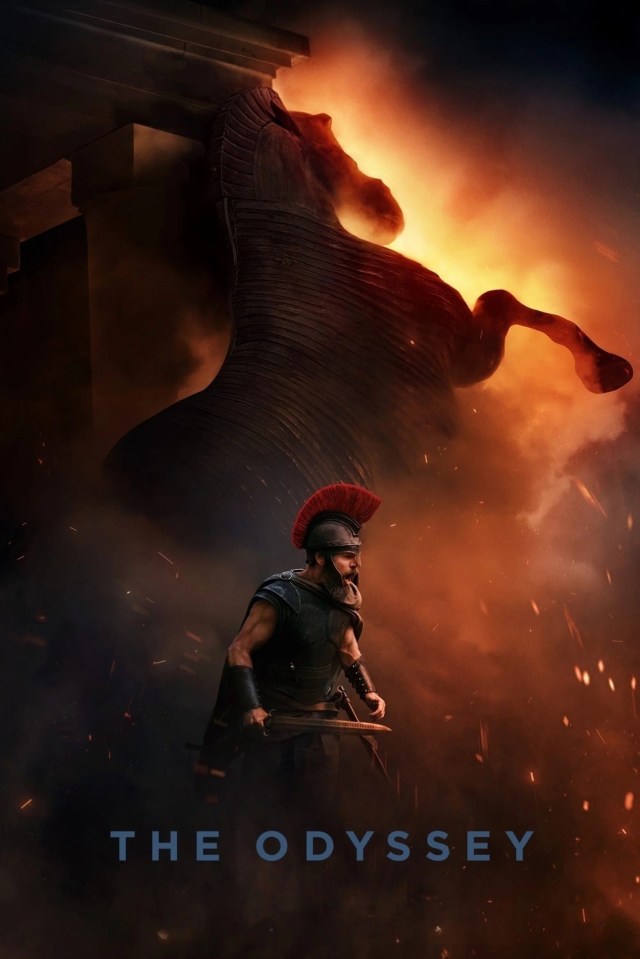
In The Odyssey, Odysseus realizes that his cleverness has violated the most sacred of the Greek gods’ laws. His insight was to offer a gift of peace and then use the advantage gained by that gift to slaughter the citizens of Troy—not just soldiers, but everyone—until achieving victory.
The cost is that this violation spreads like a contagion.
Odysseus has weaponized the fundamental societal rule (“Zeus’ law”) that strangers and visitors are to be treated with respect and trust, including the gifts they offer in the name of peace or comity. Having broken that law, distrust becomes the new rule. The “Sea People” (the Greeks returning home ahead of Odysseus) have now carried that idea forward, learning from the Trojan Horse how the presumption toward hospitality and charity can be used to take advantage of people and enrich oneself.
This is why Odysseus and his crew are greeted with abrupt, preemptive violence at almost every turn on their way home. It is the wrath of the gods in a certain sense, but the symbolic beheading of Athena is a metaphor for the practical effect of the actions of men: these Greeks, having seen the advantage given by the Trojan Horse ploy, now leverage that trust, becoming a scourge during the years they travel home. That scourge “reprograms” the social order of the region.
By the time Odysseus reaches these lands, the people meet him and his crew with fear and, if they have the means, violence.
The panic that the crew conveys in several scenes during their trek home is both a natural reaction to mortal danger and an expression of profound confusion. And that’s another subtlety that may be lost on much of a modern western audience. We have been conditioned to believe that, of course, an armed force arriving in a strange land will instantly be met with skepticism or reflexive hostility. But one of the points of the film is that, pre-Trojan Horse, that was not the case.
The controlling cultural more was for visitors to be treated kindly by default. Until Odysseus thought of the one way to penetrate the impregnable walls of Troy, leading not only to a military victory, but to indiscriminate slaughter fueled by a decade of frustration. That spark lit a fire that destroyed the high-trust society of the Mediterranean. And, upon realizing what he has wrought, Odysseus spends many years trying to forget the pain caused by his culpability in destroying the world as he knew it.
He is a man cursed, in a way, by his own prodigious capacity for perspective. It becomes apparent throughout the film that, notwithstanding Odysseus’ visions of Athena and his ability to commune with her, he is more enlightened than many of his contemporaries. He honors the wishes of the gods and dismisses the superstitions of men with equal frequency.
He is, at bottom, a pragmatist. This is why he chooses survival over properly honoring the dead. This is why he orchestrates an outcome when confronted by Charybdis that he knows will lead to the deaths of six men at the (many) hands of the Scylla. This is why he creates the Trojan Horse plan, including knowingly sending Sinon to his death.
Unlike Oppenheimer, however, Odysseus is able to escape the crumbling world he created. He enters voluntary exile and sails west, hoping to right the wrong of not properly honoring his dead.
For Oppenheimer, there is no escape. The world was too small by then.
But the parallel theme of “man’s own brilliance unwittingly unravels his world” fascinates me.
If I were to describe The Odyssey in one word, it would be “impressive.” But “impressive” isn’t the same thing as “great.” For example, Birdman was very impressive, but, after watching it once, I never felt compelled to purchase it or even watch it again.
I do think The Odyssey is very good. The pre-release criticisms of it were largely stupid. I will almost certainly own it one day. And it’s awe-inspiring.
Yet, I’m not even certain it cracks my personal top five Christopher Nolan movies.
That’s more a commentary on Nolan than this film, however. As I sit here and type this, I think I prefer The Prestige, Inception, and Oppenheimer. Probably Interstellar as well. It’s difficult to rate the Batman trilogy (less “Nolan-esque”) or to evaluate Memento because of its innovation and tiny budget compared to his later films. I definitely prefer The Odyssey to Dunkirk or Insomnia. I’m also one of the sickos who really liked Tenet. At least after I saw it twice.
Which brings me to my final point. Another consistent trait of Christopher Nolan films is that I never know for certain how I feel about them until I’ve seen them twice. In some cases (Tenet, Memento, etc.), it’s because I may not fully understand what’s happening until after the first viewing. In others (especially Interstellar), I don’t think I fully appreciate all aspects of the story until the second watch. That was one of the reasons why I saw Oppenheimer twice in a theater.
In the case of The Odyssey, I know I’ll revisit it. And, as with most Nolan films, my admiration for it is likely to grow as time goes by.


Timely Movie Review: The Odyssey
My arduous path to seeing Christopher Nolan’s The Odyssey in IMAX had a Homeric quality of its own.
Week after week, I diligently reviewed the listings for my local AMC IMAX theater. Complete sellouts gave way to a solid month of showings in which only the first three rows were available.
Refusing to spend three hours staring straight up, I waited. But waiting brought risk. Would Spider-Man occupy all of the IMAX space until The Odyssey had run its course?
Thankfully, this past weekend, I saw the film at long last. From the sixth row. Right in the middle.
It was worth the wait.
The Odyssey is a beautifully made film with an artfully told story. This is entirely unsurprising in the hands of Christopher Nolan, but so much was written and said about the film before it was even released that it’s worth mentioning this obvious truth at the outset.
The Odyssey is the kind of film that makes me want to learn more about its locations and the techniques used to create it. Famously, Nolan opts for practical effects whenever possible (see also Oppenheimer), and that preference makes the scenes in The Odyssey all the more striking.
It is refreshing in 2026 to watch a movie and think “How did he do that?” far more often than “Well, this is obviously all shot in front of a green screen with the actors staring at tennis balls on strings” or “I’m not even sure the actors are all physically in the same room.”
The visual aspects aside, the performances are generally excellent and tonally appropriate. Anne Hathaway, Tom Holland, and Jon Bernthal are all very strong. Matt Damon will undoubtedly be nominated for Best Actor, and I think Robert Pattinson has an excellent chance to win Best Supporting Actor. Pattinson’s Antinous is especially outstanding, as he perfectly balances pure evil and cowardice with strategic false nobility (which never fools Penelope).
Watching a western film set in a pre-Christian era is fascinating because the default moral framework from which westerners have been operating for, oh, about 2,000 years simply doesn’t exist yet. Certain ideas that have been offensive to most westerners for somewhere between decades and centuries, such as human and animal sacrifice, are simply a part of the religious and moral fabric of the world depicted in The Odyssey.
The core of the film is deeply rooted in the notion of the law of the gods, offending the gods, and what lessons may be taken from ruminating on those questions. And that theological framework bears some vague resemblance to our own, but its key tenets—especially for purposes of relevance to this plot—are certainly distinct. I’ll return to that in a moment. First, back to the cast.
Now that I’ve seen the movie, I’m compelled to say that the people who freaked out about the casting, or shrieked that the movie is too “woke,” seem silly at best. At worst, they’re grifting to get clicks and money from people who haven’t seen the movie and never will.
There are a few lines from Anne Hathaway that do seem a bit anachronistic and anchored in far more modern feminism, but they’re barely noticeable in the context of the larger piece. And Elliot Page should never have had a scene that involved running. As Bridget Phetasy pointed out, it’s impossible to hide or change that.
My one actual quibble with the movie is Nolan’s decision to make Clytemnestra Helen’s identical twin, rather than a half-sister, as I believe she is in the original.
I don’t care much about dramatic license taken by a filmmaker in an adaptation, so long as it doesn’t undermine a core story element. This change does so. If Helen’s is “the face that launched a thousand ships,” with her unique beauty fueling her kidnaping that sparks a war, doesn’t it weaken that impact if there is another face that is identical to hers?
Put another way, if you want me to accept that Lupita Nyong’o is a singular beauty, I’ll go with that. But if you then tell me that this singular beauty is definitionally not singular, then we have a problem.
As I said, though, this is a minor point. The movie is very good and quintessentially “Nolan.” As with all of his films, except for the Batman trilogy (which I genuinely sometimes forget are his, because they’re so straightforward), time plays a critical role as a storytelling device.
Nolan deftly uses flashback and non-sequential story beats to tie plot points together as the film progresses. The fact that the film spans roughly 20 years provides Nolan with myriad opportunities to do so. Although not as daunting as Memento or Tenet, there is an aspect of challenging the audience to connect thematically related but temporally distant events. This is one of Nolan’s many strong suits, and he handles it as expertly as ever.
He is weakened and in constant pain due to old age, abused by Penelope’s suitors, and cast out to a dung heap, barely even able to move. He has no quality of life.
Still, he lives. Waiting.
Finally, one day, Argos smells the familiar scent of his disguised master as the returning Odysseus approaches. Argos whimpers. Odysseus recognizes Argos and kneels to greet his old friend. Accompanied by a brief montage of Argos’ life, Odysseus tenderly scratches the devoted pet’s head.
Experiencing his first moment of joy in years, Argos musters one final, jubilant tail wag. Then, his work done, he peacefully expires.
If Christopher Nolan wanted to write a scene specifically designed to achieve the unlikely outcome of making me tear up uncontrollably while surrounded by strangers, well, mission accomplished.
Returning to the main point, the most interesting feature of the film for me is what happens in the final half-hour. I don’t mean the exciting, crowd-pleasing action, or the reveal that the returning Greeks were the “Sea People” that wrought terror throughout the Mediterranean following the Trojan War (a point that I don’t think is in Homer’s original).
Rather, I mean how the Odyssey takes a different path, but ultimately reaches the same destination as Oppenheimer.
In both films, the main character uses his unique insights to help win an important war. In the wake of that victory, the character slowly realizes that his efforts have changed the world—for the worse—in ways far more profound than he intended.
In Oppenheimer, this means the ushering in of the nuclear arms race, the Cold War, and the constant threat that the world as we know it could be (perhaps inevitably will be) annihilated at the literal push of a button.
In The Odyssey, Odysseus realizes that his cleverness has violated the most sacred of the Greek gods’ laws. His insight was to offer a gift of peace and then use the advantage gained by that gift to slaughter the citizens of Troy—not just soldiers, but everyone—until achieving victory.
The cost is that this violation spreads like a contagion.
Odysseus has weaponized the fundamental societal rule (“Zeus’ law”) that strangers and visitors are to be treated with respect and trust, including the gifts they offer in the name of peace or comity. Having broken that law, distrust becomes the new rule. The “Sea People” (the Greeks returning home ahead of Odysseus) have now carried that idea forward, learning from the Trojan Horse how the presumption toward hospitality and charity can be used to take advantage of people and enrich oneself.
This is why Odysseus and his crew are greeted with abrupt, preemptive violence at almost every turn on their way home. It is the wrath of the gods in a certain sense, but the symbolic beheading of Athena is a metaphor for the practical effect of the actions of men: these Greeks, having seen the advantage given by the Trojan Horse ploy, now leverage that trust, becoming a scourge during the years they travel home. That scourge “reprograms” the social order of the region.
By the time Odysseus reaches these lands, the people meet him and his crew with fear and, if they have the means, violence.
The panic that the crew conveys in several scenes during their trek home is both a natural reaction to mortal danger and an expression of profound confusion. And that’s another subtlety that may be lost on much of a modern western audience. We have been conditioned to believe that, of course, an armed force arriving in a strange land will instantly be met with skepticism or reflexive hostility. But one of the points of the film is that, pre-Trojan Horse, that was not the case.
The controlling cultural more was for visitors to be treated kindly by default. Until Odysseus thought of the one way to penetrate the impregnable walls of Troy, leading not only to a military victory, but to indiscriminate slaughter fueled by a decade of frustration. That spark lit a fire that destroyed the high-trust society of the Mediterranean. And, upon realizing what he has wrought, Odysseus spends many years trying to forget the pain caused by his culpability in destroying the world as he knew it.
He is a man cursed, in a way, by his own prodigious capacity for perspective. It becomes apparent throughout the film that, notwithstanding Odysseus’ visions of Athena and his ability to commune with her, he is more enlightened than many of his contemporaries. He honors the wishes of the gods and dismisses the superstitions of men with equal frequency.
He is, at bottom, a pragmatist. This is why he chooses survival over properly honoring the dead. This is why he orchestrates an outcome when confronted by Charybdis that he knows will lead to the deaths of six men at the (many) hands of the Scylla. This is why he creates the Trojan Horse plan, including knowingly sending Sinon to his death.
Unlike Oppenheimer, however, Odysseus is able to escape the crumbling world he created. He enters voluntary exile and sails west, hoping to right the wrong of not properly honoring his dead.
For Oppenheimer, there is no escape. The world was too small by then.
But the parallel theme of “man’s own brilliance unwittingly unravels his world” fascinates me.
If I were to describe The Odyssey in one word, it would be “impressive.” But “impressive” isn’t the same thing as “great.” For example, Birdman was very impressive, but, after watching it once, I never felt compelled to purchase it or even watch it again.
I do think The Odyssey is very good. The pre-release criticisms of it were largely stupid. I will almost certainly own it one day. And it’s awe-inspiring.
Yet, I’m not even certain it cracks my personal top five Christopher Nolan movies.
That’s more a commentary on Nolan than this film, however. As I sit here and type this, I think I prefer The Prestige, Inception, and Oppenheimer. Probably Interstellar as well. It’s difficult to rate the Batman trilogy (less “Nolan-esque”) or to evaluate Memento because of its innovation and tiny budget compared to his later films. I definitely prefer The Odyssey to Dunkirk or Insomnia. I’m also one of the sickos who really liked Tenet. At least after I saw it twice.
Which brings me to my final point. Another consistent trait of Christopher Nolan films is that I never know for certain how I feel about them until I’ve seen them twice. In some cases (Tenet, Memento, etc.), it’s because I may not fully understand what’s happening until after the first viewing. In others (especially Interstellar), I don’t think I fully appreciate all aspects of the story until the second watch. That was one of the reasons why I saw Oppenheimer twice in a theater.
In the case of The Odyssey, I know I’ll revisit it. And, as with most Nolan films, my admiration for it is likely to grow as time goes by.
Share this:
Related