
The debate over Indiana’s version of the Religious Freedom Restoration Act has already taken some curious twists and turns.
The initial response from opponents was to go to the playbook that has been so wildly successful over the past five years—label the law as “hate,” condemn its proponents, create wild scenarios that conjure Nazi-esque horrors.
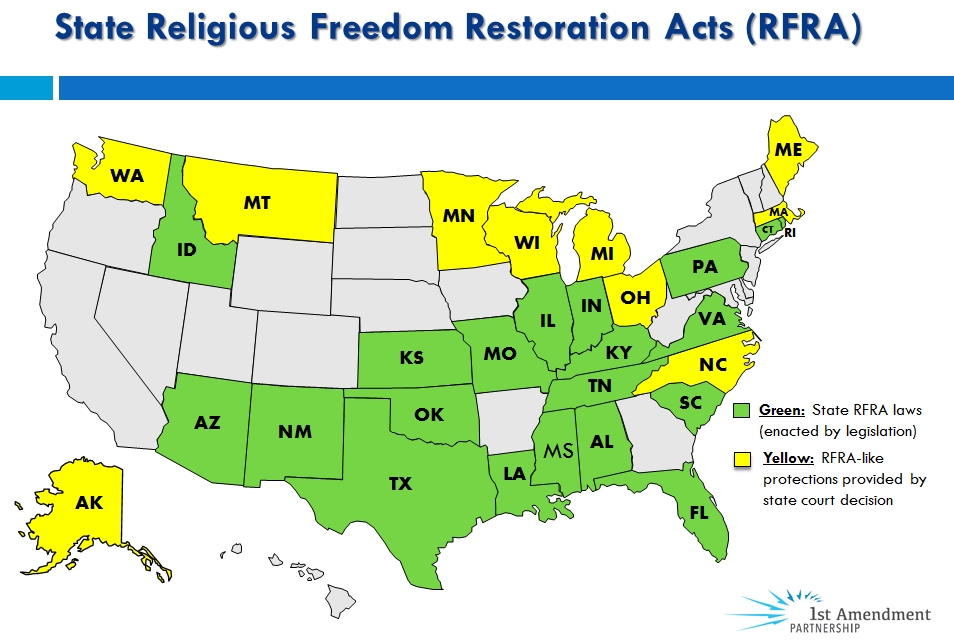 Except something was different this time. The law’s critics, probably overconfident because of their long winning streak, got a little sloppy. Their blanket condemnations were met on this occasion by some defiant, salient points from the other side. Namely, that numerous other states and the federal government have had similar laws for years, and, yet, somehow, those jurisdictions have avoided the descent into Jim-Crow-esque regimes promised as a certainty by opponents.
Faced with these inconvenient facts, RFRA critics have chosen two paths: One, taken by those like Apple’s Tim Cook, has been to ignore the realities of the application and history of these laws, and simply to continue to drum up opposition. Even politicians are not immune to this phenomenon. Now-Senator Chuck Schumer sponsored the original RFRA bill as a member of Congress, but condemned Indiana’s version this week. Governor Dan Malloy of Connecticut issued a ban on state-funded travel to Indiana over the RFRA, but his own state actually has an RFRA with broader language in some respects than Indiana’s legislation.
The second path has been to distinguish the Indiana law from other RFRAs because of some slightly different procedural points that permit its use as a defense in actions between private parties, rather than simply those where the state is a party. As noted by the Washington Post, this is a somewhat inconsequential distinction. However, critics have to highlight this difference to avoid an embarrassing situation in which many “good” states have this law, and where, for example, people like Barack Obama (as a state legislator) voted for these measures.
The reality is that, if someone opposes the IN-RFRA on the grounds that it might someday allow a court to find a conservative Christian may be able to decline to service a gay wedding, then that opposition should extend to some of the other RFRAs as well.
All these laws do, in fact, is plug a hole created by Employment Division v. Smith, a 1990 Supreme Court case which—briefly—held that laws of general applicability need not receive the highest level of scrutiny used in certain other First Amendment cases. The idea is that, if a law is simply a general one that happens to conflict with particular practices of a religion, it has a lower constitutional hurdle to clear than a law that specifically impacts religious practices.
The RFRA was an attempt to elevate such cases to the same strict-scrutiny standard that applies in cases involving direct infringement upon the free exercise of religion. That standard doesn’t mean that the plaintiff always wins, it means that the government must prove that it is advancing a compelling state interest in order to justify its alleged infringement on religious exercise.
A later case, Boerne v. Flores, held that the federal RFRA could not be used in state-level cases. That decision prompted a long list of states to adopt their own versions of the RFRA over the next several years. The laws have been used in a variety of contexts to protect religious objectors who seek to be absolved from following certain laws that clash with their religious beliefs, such as a ban on facial hair in a prison, or regulations pertaining to wheeled conveyances that are in conflict with Amish religious and cultural traditions.
The Mother Jones and Gawker crowds would have you believe the RFRA is something close to apocalyptic, but a decade or two of actual experience with these laws strongly suggests otherwise.
So, what’s really going on, here?
This is part of a bigger cultural shift—one I’ve discussed in the past.
 That tradition carried on beyond 1985, of course—to the point where the WWF/WWE created a separate “wing” of its not-physically-real Hall of Fame just for celebrity involvement.
 With the news that University of Oklahoma President David Boren would be expelling two members of the SAE fraternity for singing a racial-slur-laden song, there has been an expected uptick in First Amendment experts in the comments sections of the news sites and social media outlets I frequent.

 About two months ago, I began commuting to Washington for a new job. Something very odd happened that first week, during one of the three days I spent in DC.
 A new job and shifting responsibilities caused my blog-related productivity to slip a bit. Overall, I published “only” 41 pieces in 2014, including this one.


 The Axis of Ego
Untimely Movie Review: Gigi
After watching Gigi, I’m now more irritated than ever before that Saving Private Ryan didn’t win Best Picture.
This is Maurice Chevalier’s Honore Lachaille, and his registry-worthy performance is the jumping-off point of the story of Gigi, played by Leslie Caron. You may remember her from An American in Paris, an earlier film in this collection. What follows are various half-sung songs and scenes of upper-class French doing upper-class French things.
My favorite moment was perhaps Gigi’s aunt complaining about Gigi learning English in school, saying that English-speakers refuse to learn French. Like all her lines, she delivers this lament with an English accent.
There’s no reason to belabor this review. Gigi won Best Picture in an era where set design, costumes, and merely being a period piece in Paris carried a lot of weight with voters. That honor seems downright perplexing today.
The basic story is obviously the romance between Gigi and Gaston Lachaille, played by Louis Jourdan, best-remembered as Kamal Khan in Octopussy. Or maybe that’s just me.
The story itself is also odd. To wit, there is much congratulation thrown Gaston’s way when the discovery of his fiancee’s infidelity causes her to attempt suicide. The plot also seems to borrow heavily from My Fair Lady, minus the charm. That’s possibly not entirely a coincidence, as the same duo, the renowned Lerner and Loewe, wrote the songs for both films.
Cutting to the chase, this movie stinks. And I can’t just chalk this up to my anti-musical bias—because it’s barely a musical, given the fact that the actors speak their way through most of the lyrics. It’s a film where the story is alternately creepy and boring, and the ultimate outcome of the plot is never in doubt.
Is it a musical? I don’t know—are they singing? Is it a comedy? I don’t know—I’m not laughing.
As outstanding and genuinely funny as Singin’ in the Rain was, this is the opposite.
If you’re looking for a positive, I will say that the special features on the blu-ray are very comprehensive and impressive. In fact, one of the special features is an entire film—the 1949 French version of Gigi, complete with subtitles.
That’s about all I can muster on the plus side.
This is the worst film I’ve reviewed from this collection.
Share this: