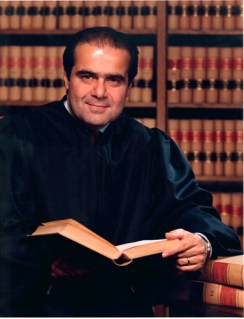
 Justice Antonin Scalia authored a Supreme Court opinion published today that curtailed certain kinds of police searches using drug-sniffing dogs. The holding in Florida v. Jardines was that such searches are unconstitutional and a violation of the rights secured by the Fourth Amendment. Scalia notably lead a 5-4 majority that included “liberal” justices Elena Kagan, Sonia Sotomayor, and Ruth Bader Ginsburg, in opposition to the “conservative” minority that included Chief Justice Roberts and justices Samuel Alito and Anthony Kennedy (along with Stephen Breyer).
Don’t expect to hear all that much about this decision in the days to come.
No, the primary thrust of the Scalia-related coverage over the next week will be what an intolerant, ignorant monster he is. He’ll be roundly criticized for his judicial philosophy by people who have never so much as read the entirety of the Constitution. A few choice quotes will be bandied about by certain websites as grist for their ideological mill.
So, I write today to defend a man whose intellect I unashamedly admire—a man who really needs no defense in the first place.
Perhaps the most-talked-about exchange during today’s Supreme Court Prop 8 oral argument (and certainly the one of most interest to me personally) was this one, between Justice Scalia and Ted Olson. It’s somewhat-lengthy, but worth the read. I’ll comment at the end:
MR. OLSON: The California Supreme Court, like this Supreme Court, decides what the law is. The California Supreme Court decided that the Equal Protection and Due Process Clauses of that California Constitution did not permit excluding gays and lesbians from the right to get married-
JUSTICE SCALIA: You — you’ve led me right into a question I was going to ask. The California Supreme Court decides what the law is. That’s what we decide, right? We don’t prescribe law for the future. We–we decide what the law is. I’m curious, when -when did — when did it become unconstitutional to exclude homosexual couples from marriage? 1791? 1868, when the Fourteenth Amendment was adopted? Sometimes — some time after Baker, where we said it didn’t even raise a substantial Federal question? When — when — when did the law become this?
Continue reading →

 Unless SitCombat reformulates around different shows, this will be the last regular edition of the feature. Archer’s season concluded tonight, leaving only one show left to evaluate. Less than a minimum of two programs quite obviously means no competitive aspect is possible.
 When we left our heroes in
  One could make a fair argument that, in retrospect, the last two WrestleManias were merely prologue to this year’s event.
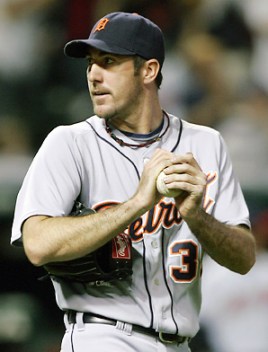 The news last week that local athlete Justin Verlander had signed the
  Today, my interest in college basketball pre-March is minimal at best. I follow the University of Richmond, and I’m vaguely aware of how other state schools are doing. VCU is essentially ubiquitous at this point, and knowledge of their performance will seep through whatever informational filters any Richmond resident has, even if one tries to avoid it. Trust me.


The Fatal Mistake
In the aftermath of the bombing of the Boston Marathon, about which many details are still unknown, several thoughts immediately came to mind as the limited facts trickled in.
The second thing I thought of was how adept I’ve become at desensitizing myself to these sorts of events. That’s sad in and of itself, of course, but that instinct emanates from an even darker place beneath the surface: I accepted it as a given a long time ago that a nuclear weapon will inevitably be detonated on American soil at some point during my lifetime. I often wonder whether our collective psyche will be able to recover from the various horrors that event will entail, the specifics of which I won’t go into here, to say nothing of the massive death count that would dwarf anything we’ve ever seen.
Naturally, I hope and pray that I’m wrong.
But there’s something else, too. As with any terrorist attack, there are always folks on Facebook and Twitter who are quick to label the perpetrators as “cowards.” I believe this to be a huge mistake—a mistake that matters when formulating a crucial understanding of the enemy we face.
Continue reading →
Share this: