As the Warner Brothers 50 Film Collection moves into a new decade, the first movie from the 1950s is another story based on a play: Tennessee Williams’ A Streetcar Named Desire (which I will refer to simply as Streetcar to signal my credibility to the readers!).
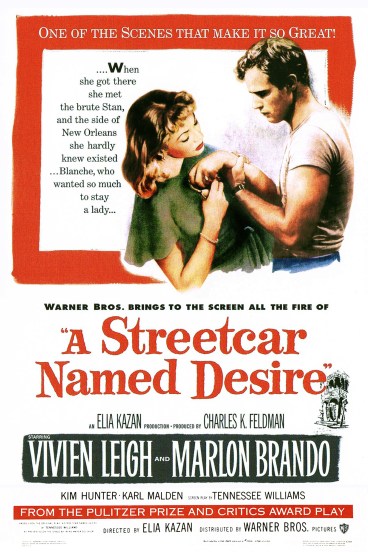 Streetcar (see?!?) directed by Real American Elia Kazan, tells a very “small” story, reflecting its stage roots. The crux of the plot is that a woman named Stella has a nutty sister (Blanche) who arrives in New Orleans to live with Stella and her abusive husband Stanley. Blanche’s past is mysterious, and her behavior is odd—she needs frequent praise for her looks, a point her sister drives home more than once. Blanche also perpetually asks questions about what people think about her. The eventual revelations about her past are interesting, but not unexpected, given her strange conduct throughout the film.
Story aside, there are problems with the dialogue. Jeepers, this dialogue. It’s more music than words, for better and for worse. The sounds portray the intensity and emotion of the scene, but nobody talks this way. Not in 2014. Not in 1951.
The lines sound exactly like what they are: Short, impactful doses of words designed to hold the attention of the couple in the last row of a playhouse. Viewed with the scrutiny of a close-up on a large screen, they get silly very quickly.
Also note that we’re still in an era of acting that favored broad, melodramatic performances. The fact that the source material is a stage production only ups that particular ante. Vivien Leigh, funny and excellent in the 30s epic Gone with the Wind, now seems a little out-of-place in the 1950s, especially acting alongside Marlon Brando.
In fact, seeing Brando and Leigh together is a bit jarring. It’s almost as if they’re acting in two different movies. Or, more properly, Leigh is acting in a melodrama from the 1940s, and Brando is delivering something close to a “modern” performance.
Brando is acting. Leigh is ACTING!
The contrast doesn’t do Leigh any favors, although she won another Best Actress Oscar for her performance.
Karl Malden and Kim Hunter swept the supporting role Oscars as well. In fact—incredibly—Marlon Brando is the only primary cast member who didn’t win an Oscar for his performance in Streetcar. Seen from a contemporary perspective, that seems quite odd. I think it’s also probably surprising for people who only know this movie from the “STELLA!!!” scene to discover that Brando easily has the most subtlety and nuance.
But, again, that’s not entirely Leigh’s fault. Some of her lines are a volcano of unnatural syllables, particularly strange to hear erupting from the mouth of a past-her-prime Mississippi schoolteacher. However, there are also moments like (to pick just one) her reaction when Brando gives her the bus ticket back home that illustrate the broad tone of Leigh’s performance.
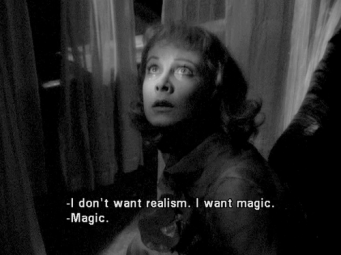
So we noticed.
In some ways, the character Leigh plays here is where we might imagine an older Scarlett O’Hara would wind up at the same age—alone, alcoholic, missing her erstwhile beauty and lost family estate. The difference is that O’Hara, at bottom, had a resilient, capable spirit. Blanche is a mess who just gets messier over the course of two hours.
Brando is the major selling point for me. His is the first performance I’ve seen in this collection that wouldn’t have seemed bizarre 20 years later. His popularity coupled with his different approach to acting would help usher in a shift toward a more natural, realistic approach to the craft.
This is ultimately a story about two very flawed people (and one who loves and tolerates both of them). Brando is great. Leigh’s effort won her an Academy Award, but was the sort of performance whose days as Oscar-winning were numbered. Hunter and Malden fall somewhere in-between.
Streetcar was rated as one of the 100 best films in movie history by AFI. One of the 50 best, in fact. As always, there’s a risk of a disconnect watching it for the first time more than a half-century after its initial release. However, I don’t think it merits that level of acclaim.
That’s not to say it isn’t a good film. Of course it is. But I just can’t get past the unnatural stage dialogue or the antiquated performance of Leigh juxtaposed with Brando’s must-see naturalism.

 Not only that, but he perpetrated those acts against then-WWE Champion and “face of the company” John Cena.

 In just a few days’ time, shrewd businessman and creative genius Vince McMahon’s troupe of fairly compensated independent contractors will put on their second-biggest show of the year.





 The last of the three Humphrey Bogart films in the


 The Axis of Ego
Untimely Movie Review: An American in Paris and Singin’ in the Rain
The next two movies in the Warner Bros. 50 Film Collection are a pair of Gene Kelly musicals I’ll review in tandem: An American in Paris and Singin’ in the Rain. These films present something of a dilemma for me as a “reviewer,” a term I use in the loosest sense allowable.
Let’s see how this goes.
The 1951 winner for Best Picture, An American in Paris is the story of Jerry Mulligan (Kelly) persistently stalking and, it being 1951, therefore successfully wooing Lise (Leslie Caron). The plot is really just a simple contrivance to get from one musical number to another, not that that’s necessarily a bad thing.
Back to that dilemma I mentioned a moment ago. There’s the question of my personal taste versus the objective merit of the movies. An American in Paris just didn’t appeal to me subjectively. Objectively, on the other hand, there’s no question that this is an incredibly well-crafted production worthy of the acclaim it received back in the early 50s.
Continue reading →
Share this: